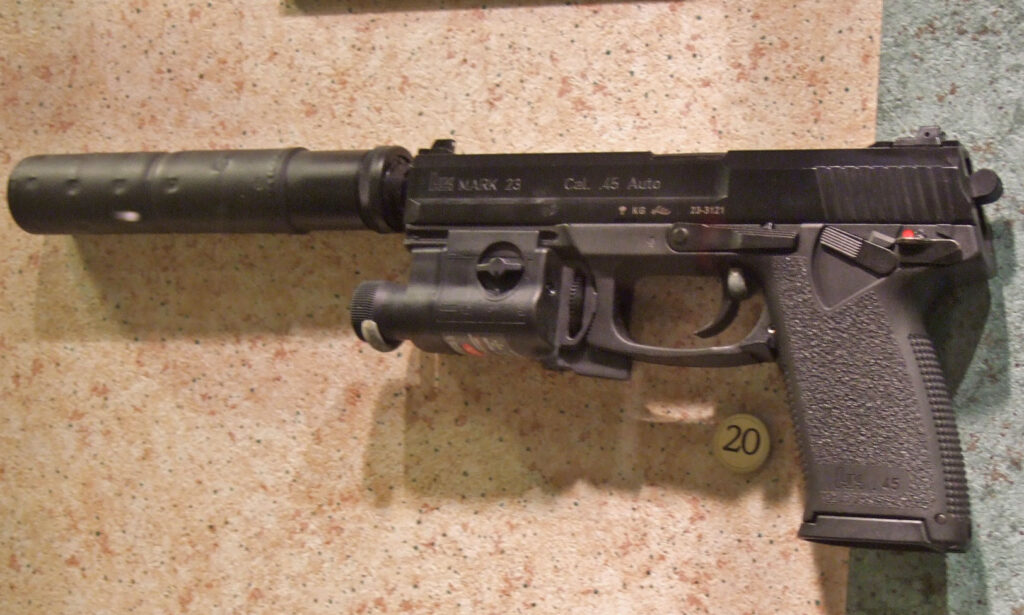
Accuracy, reliability and suppressed performance drove the HK Mk23 Mod 0 programme. Developed for U.S. Special Operations Command (USSOCOM), the pistol formed one part of the Offensive Handgun Weapon System (OHWS), alongside a suppressor and Laser Aiming Module (LAM). Its bulk was the price of those priorities: endurance, consistent performance and substantial engineering margins.
For a maritime unit, a sidearm earns its place in the loadout through the complete mission, including any submerged phase. This dossier examines the OHWS through its design, published trials and documented employment. The military HK Mk23, civilian HK Mark 23 and later accessory configurations are treated separately throughout.
The essentials
- System. HK describes a .45 ACP (Automatic Colt Pistol) pistol, suppressor and laser aiming module. The assessment concerns the complete package, not just the handgun.
- Trials. The published accuracy, reliability and endurance figures come from HK. Its public manual summarises the results but does not reproduce the complete government test record.
- Service. HK dates the first military deliveries to 1996. Dave Hall describes testing and subsequent employment in a maritime U.S. Navy SEAL (Sea, Air and Land) and SEAL Delivery Vehicle (SDV; swimmer transport) setting. His account does not establish general issue across all SEAL units.
- Civilian derivative. Fitting accessories to a civilian HK Mark 23 does not, by itself, recreate the historical OHWS.
Sources: HK Operator’s Manual and 1911 Syndicate’s interview with Dave Hall. The technical sections identify passages and evidential limits.
European connection: Heckler & Koch is a German manufacturer. The programme and documented employment discussed here are American; neither establishes service with European forces.
Source context and assessment
The main openly available technical source is HK’s Operator’s Manual. It describes the OHWS as a .45 ACP pistol with a detachable sound/flash suppressor—often called a “can”—and Laser Aiming Module (LAM). HK now provides it through civilian support, but its title page covers both HK Mark 23 and HK Mk23 Mod 0 pistols. The reviewed material contains no public government system manual covering the Knight’s Armament Company (KAC) suppressor and AN/PEQ-6 as well.
Evidence boundary: the manual describes the pistol and presents the manufacturer’s summary of the trials. It is neither the government test report nor a complete set of instructions for all three components. HK USA states that military and law-enforcement product manuals are not distributed publicly. HK USA FAQ
The design prioritised accuracy, reliability, service life, suppressed operation and environmental resistance. The published requirement was at least 2,000 Mean Rounds Between Stoppages (MRBS) with M1911 ball and +P ammunition. HK reports a lowest achieved value of 6,027 and a highest value of 15,122 MRBS—approximately three and 7.6 times the requirement respectively. According to HK, endurance testing exceeded 30,000 rounds of +P ammunition without a parts failure; the slide and frame were certified for a further 30,000 rounds. Three pistols reportedly continued to meet the new-weapon accuracy requirement after more than 30,000 rounds each. The figures indicate substantial margins above the requirement. A full independent assessment remains impossible without the official raw data.
Former Navy SEAL Senior Chief Dave Hall supplies a first-hand perspective. He describes testing in early 1995 and later mission-specific employment with SEAL Delivery Vehicles (SDVs), flooded underwater transport vehicles for combat swimmers. His account concerns that particular maritime role, not the experience of every SEAL team.
The civilian HK Mark 23, now marketed as the HK MARK 23, is nearly identical to the military pistol according to HK. Documented differences are the slide markings and a barrel made to headspace specifications of the Sporting Arms and Ammunition Manufacturers’ Institute (SAAMI). Neither different rifling nor altered fouling tolerance follows from that. Accessories do not turn it into a military OHWS: the pistol in the Garand Thumb video from 05:38 combines a B&T suppressor, a ZR Tactical slide cut for an Aimpoint ACRO and a Wilcox Nightstalker. This documents an individual configuration, not an HK package or historical HK Mk23 Mod 0 OHWS.
Publisher Uwe Betz owns a civilian HK Mark 23 in Flat Dark Earth (FDE). This privately owned example is distinct from the military HK Mk23 Mod 0 and the complete OHWS.
HK Mk23, HK Mark 23 and OHWS: what do the names mean?
| Term | Subject | Editorial distinction |
|---|---|---|
| OHWS | Complete system comprising pistol, suppressor and LAM | Not the pistol alone |
| HK Mk23 Mod 0 / HK Mk23 | Military pistol or military system component | Not automatically every pistol bearing USSOCOM markings |
| HK Mark 23 / HK MARK 23 | Commercial civilian model | Not an authentic OHWS without the original system components |
A civilian HK Mark 23 with a can fitted can look convincingly “SOCOM”. Appearance is not provenance. Photographs and videos establish the configuration in front of the camera; they do not establish that it matches the OHWS fielded in 1996. Meaningful comparison starts with identifying the pistol and each accessory.
Evidence status at a glance
Manufacturer documentation, first-hand testimony and specialist reporting answer different questions. Each source must be assessed against the particular claim it supports and the independent confirmation still missing.
Legend: source classes
The classes identify provenance and the basis for verification. They are not universal quality scores: a primary source can have a vested interest, omit important detail or contradict itself. Its value depends on the claim being assessed.
- A – primary documents: official records, manufacturer documents, patents and standards; evidence within their respective scope.
- B – first-hand evidence: participation, use or documented examination of an object; confined to the role, period and example observed.
- C – secondary reporting: specialist publications and critically assessed user reports; important claims require a primary-source cross-check where possible.
- D – research leads: indirect, compiled or insufficiently substantiated claims; useful starting points, not conclusive evidence.
A mixed classification such as B/C or C/D means that a source contains more than one kind of evidence. The relevant limitation is stated in the table.
| Statement | Status | Source type | Strongest public evidence | Class |
|---|---|---|---|---|
| OHWS comprised pistol, suppressor and LAM | Documented | Manufacturer document | HK Operator’s Manual | A |
| Project began in 1991; first delivery on 1 May 1996 | Documented as an HK statement | Manufacturer document | HK Operator’s Manual; HK Defense | A |
| Requirement of at least 2,000 MRBS | Documented published requirement | Manufacturer document | HK Operator’s Manual | A |
| 6,027–15,122 MRBS and more than 30,000 rounds of +P | Manufacturer summary; official raw data unavailable | Manufacturer document | HK Operator’s Manual; HK Defense | A |
| Quiet and safe decocking as a design function | Documented manufacturer description | Manufacturer document | HK Operator’s Manual | A |
| KAC suppressor and Insight LAM in the procurement-era final configuration | Strong visual evidence | Object presentation and specialist publication | Object access in the former HK Grey Room; specialist publications | B/C |
| Dave Hall’s participation in testing and later SDV use | Identified first-hand account | Participant account | 1911 Syndicate interview | B |
| Safariland/Rogers holster as an early military carry holster | Contemporary report; contract or packing list unavailable | Specialist publication | Soldier of Fortune, December 1997 | C |
| Several subsequently issued carry and swim holsters | Identified first-hand account | Participant account | Dave Hall in the 1911 Syndicate interview | B |
| Over the Beach (OTB) requirement or firing from a depth of 0.5 metres | Not documented for the HK Mk23 | Insufficient evidence | Insufficient evidence; HK instructs the user to drain the barrel | — |
| General standard pistol of all Navy SEALs | Not documented | Insufficient evidence | Insufficient evidence | — |
| International user lists | Not reliably documented | Unconfirmed user list | Official unit-specific evidence unavailable | D |
| Exact total number of complete OHWS procured | Open | Contract/acceptance record unavailable | No publicly accessible contract or acceptance record | — |
The requirement—and the cost in size and weight
HK dates the programme’s start to 1991. The brief called for a special-operations handgun system combining .45 ACP, accuracy, suppression, target designation and durability. “Offensive handgun” describes that requirement; it does not establish an intention to replace rifles and submachine guns across the board.
Even before accessories, the pistol is substantial: 245 millimetres overall, a 149-millimetre barrel and 1.21 kilograms with an empty 12-round magazine. Add the suppressor and LAM, and both weight and forward balance change. The complete package has to work with the user’s carry kit.
That size accommodates:
- .45 ACP ammunition, including +P loads,
- a substantial one-piece steel slide,
- a recoil-spring and buffer assembly,
- a long threaded barrel with O-ring centring,
- raised sights for suppressed use,
- operation with gloves and robust controls,
- repeatable accuracy with and without the suppressor.
From prototype to fielded configuration
Public documents and surviving prototypes reveal the principal design changes. They only partly reconstruct the formal contractual phases:
| Date/phase | Publicly supportable development step | Assessment |
|---|---|---|
| 1991 | HK dates the start of the OHWS project and a development requirement | Manufacturer statement |
| Early development | Prototype 23-005 with slide lock, early HK suppressor and large LAM | Visible material evidence in the former HK Grey Room |
| Revised development | Prototype 23-042 without slide lock, revised grip texture, magazine floorplate and booster-equipped suppressor | Visible material evidence; phase designation is secondary |
| Early 1995 | Dave Hall describes participation in intensive user and environmental trials | Identified oral history |
| Procurement-era final configuration | Slimmer KAC suppressor and more compact Insight LAM | Visible material evidence in the former HK Grey Room |
| 1 May 1996 | First HK Mk23 pistols delivered to USSOCOM for operational use according to HK | Manufacturer statement |
| 2003–2007 | Hall reports regular use in his SDV and reconnaissance environment | Identified oral history; not transferable to all units |
The development task extended beyond building a large service pistol. Suppressor, action, aiming module and handling had to work together. Changes to individual components and feedback from trials shaped the later configurations.
Technical reference card
The figures below describe the pistol as specified in HK’s Operator’s Manual. They are not specifications for the complete OHWS with suppressor and LAM fitted.
| Characteristic | HK Mk23 / HK Mark 23 |
|---|---|
| Military stock number | NATO Stock Number (NSN) 1005-01-426-8951 according to the HK manual |
| Calibre | .45 ACP |
| Operating principle | Short recoil, locked breech |
| Locking system | Modified linkless Browning system |
| Trigger | Double-action/single-action (DA/SA) |
| Overall length | 9.65 in (245 mm) |
| Barrel length | 5.87 in (149 mm) |
| Height without magazine | 5.90 in (150 mm) |
| Frame width | 1.58 in (38.8 mm) |
| Weight with empty 12-round magazine | 2.66 lb (1.21 kg) |
| Magazine capacity | 10 or 12 rounds |
| Sights | Raised, adjustable for windage and elevation; three-dot or optional tritium |
| Barrel | Threaded, polygonal profile, O-ring centring |
| Safety/decocking | Ambidextrous manual safety; separate decocking lever intended by HK to lower the hammer quietly and safely |
Internal dimensional discrepancy in the HK manual: Page 7, “HK Mark 23 Pistol Specifications”, lists the frame width as 1.58 in and 38.8 mm. Converting 1.58 inches gives approximately 40.13 mm. The discrepancy is within the same source, not between the manual and another publication. Both original values remain documented; this does not establish which value requires correction.
Source: HK Mark 23 Operator’s Manual, sections 1–4 (manufacturer primary source for the pistol, not a complete OHWS system manual).
Military and civilian barrels: the documented difference
The documented distinction is headspace. HK states that the civilian barrel follows Sporting Arms and Ammunition Manufacturers’ Institute (SAAMI) headspace specifications. This concerns the dimensional relationship between chamber, cartridge and breech face—not the rifling. The manual specifies polygonal rifling for both pistols. It does not support the claim that military barrels use conventional rifling while civilian barrels are polygonal.
The military drawing and its acceptance dimensions are not available for comparison. The civilian specification is documented; the precise dimensional differences, and any overlap between permissible ranges, remain unresolved.
A more generous military specification could affect fouling tolerance, case support, accuracy or ammunition compatibility. That remains a hypothesis. Without both sets of dimensions and controlled testing, greater fouling sensitivity in the civilian pistol cannot be established.
For comparison, SAAMI publishes separate cartridge and chamber drawings, with defined dimensional limits, for .45 Auto and .45 Auto +P. ANSI/SAAMI Z299.3
What the published trials actually establish
A central objective was high accuracy with interchangeable production components. HK’s manual describes a requirement for five-shot groups measuring less than 2.5 inches in maximum extreme spread at 25 metres with service ammunition. It reports more than 450 “accuracy test firings” from a fixture, with an average maximum group diameter of 1.44 inches. Of the reported groups, 65 measured less than one inch and four approximately 0.5 inch. The wording does not make clear whether “450” counts individual shots or complete groups.
These results need three qualifications:
- They are a manufacturer summary of the trials.
- Fixture-fired results do not describe unsupported shooting under operational conditions.
- The full dataset is not public: individual pistols, ammunition, suppressor fit and outlier criteria cannot be checked independently.
An HK patent explains the design approach: resilient centring elements limit barrel movement near the muzzle without preventing the Browning action from tilting. The barrel O-ring belongs to that centring concept. US5654519A – Automatic pistol
HK states an O-ring service life exceeding 20,000 rounds. Claims of shorter intervals, or that gas pressure makes the ring “swell”, need separate support. The patent describes resilient barrel centring, not a gas-pressure-driven mechanism.
Reliability and endurance: MRBS
Mean Rounds Between Stoppages (MRBS) is a round-count measure of reliability. HK states a minimum requirement of 2,000 MRBS with both M1911 ball and +P ammunition. A time-based label such as “Mean Time Between Fault” is not an equivalent measure.
| Criterion | Published value | Assessment | Source type | Class |
|---|---|---|---|---|
| Reliability requirement | At least 2,000 MRBS | With M1911 ball and +P | Manufacturer document | A |
| Lowest achieved MRBS | 6,027 | Approximately 3.0 times the requirement | Manufacturer document | A |
| Highest achieved MRBS | 15,122 | Approximately 7.6 times the requirement | Manufacturer document | A |
| Endurance trial | More than 30,000 rounds of +P without a parts failure | HK manufacturer summary | Manufacturer document | A |
| Slide and frame | Certified for a further 30,000 rounds | Published wording leaves test method open | Manufacturer document | A |
| Accuracy after endurance | Three pistols still met the new-weapon requirement after more than 30,000 rounds | Manufacturer summary | Manufacturer document | A |
The reported values exceed the requirement by a wide margin. They should not be reduced to “30,000 trouble-free rounds”: stoppages and parts failures are different measures, and the manual does not publish the full definitions, exclusions or raw results. Christopher R. Bartocci states that only the barrel O-ring was replaced on the three 30,000-round pistols. That is a secondary account, not the government trial record.
HK’s accounts differ on MRBS: the January 2024 manual gives 6,027 as the lowest and 15,122 as the highest result. HK Defense describes roughly 6,000 as the average. The underlying dataset would be needed to reconcile these statements.
Recoil buffering and controllability
The spring assembly is intended to spread the recoil impulse over time. HK’s patent describes additional spring and mass elements intended to soften barrel and slide impulses, reduce component loading and improve controllability. US5309815A – Firearm, particularly handgun
The manual claims a recoil-force reduction of “up to 30 percent”. That is an upper value under the manufacturer’s test conditions, not a universal result for every load. The buffer provides the engineering basis for the manageable recoil often attributed to this large .45-calibre pistol.
Saltwater exposure, environmental trials and OTB
HK lists immersion, surf and salt spray among the environmental trials, together with sand, dust, mud, insufficient lubrication and other contamination. The special maritime finish was intended to resist corrosion. These are manufacturer-reported environmental qualifications; their scope matters.
What “Over the Beach” means
Over the Beach (OTB) concerns the transition out of a water phase. It does not, on its own, mean that a weapon is cleared to fire underwater. Any assessment must retain the specific system’s documented requirements for drainage, waiting periods and ammunition.
The public HK Mk23 material reviewed establishes neither an explicitly named OTB requirement nor a requirement to fire from 0.5 metres under water. Under “Heavy Rain and Water Operations”, HK requires drainage and drying of the bore with a cleaning wick and rod before firing. This supports maritime use, not underwater firing or immediate firing with a water-filled barrel.
For the HK SFP9 M, Roth (2022, p. 19, footnote 21) reports internal company firing trials at a depth of 50 cm. The linked article explains this account and its evidential limits. This does not establish an equivalent requirement or trial for the HK Mk23.
For the HK Mk23: maritime environmental resistance is reported by the manufacturer; an explicitly named OTB requirement is not established; firing from a depth of 0.5 metres is not established. The 0.5-metre depth is documented in internal company trials of the HK SFP9 M (Roth, 2022, p. 19, footnote 21). The sources reviewed here document neither an equivalent requirement nor such a trial for the HK Mk23.
A maritime finish does not make a pistol maintenance-free. The manual still requires lubrication of specified metal parts, rails, locking surfaces, the spring assembly and O-ring. Resistance to saltwater and freedom from servicing are different propositions.
The OHWS as a complete system
HK defines the OHWS as pistol, suppressor and LAM. Historical presentations and collector documentation associate the fielded U.S. configuration with a Knight’s Armament Company (KAC) suppressor and an Insight module, usually identified as the AN/PEQ-6. That established specialist attribution contains more detail than the public pistol manual itself.
Pistol
The pistol provides the mechanical core: twelve rounds of .45 ACP in the military magazine, a threaded barrel, raised sights, O-ring barrel centring and a recoil buffer. The safety and decocking lever are separate controls. HK describes decocking as quiet and safe; that description is not an acoustic measurement of an individual pistol.
Suppressor: part of the requirement, not an afterthought
Suppressed operation was part of the requirement; the manual describes function and accuracy tests with and without the suppressor. An early prototype also had a mechanical slide lock requiring manual cycling. Trial participant Dave Hall identifies the publicly shown example as an early prototype and describes using it. 1911 Syndicate, prototype and slide lock, 31:39–38:45
When you play this video, YouTube/Google processes connection and usage data and may store or access information on your device. Processing in the United States is possible. By pressing Play, you consent for this video; you can withdraw activation using “Remove video”. Privacy.
The production pistol dispensed with the slide lock. Hall’s interview attributes the decision to the sound reduction available from a wet suppressor while retaining rapid follow-up shots. It is a plausible participant explanation, not a published record of the formal decision.
A civilian demonstration of the historical KAC suppressor shows its short threaded mounting and reliable operation on a commercial HK Mark 23. Five displayed readings at the right ear range from 133.4 to 135.9 dB. Without independently verified calibration and a full measurement protocol, they are neither government acceptance data nor proof of a universally “hearing safe” configuration. Military Arms Channel, KAC mounting 03:50–04:23 and measurement series 12:08–14:20
Laser Aiming Module (LAM)
The LAM provides aiming and illumination through a proprietary frame interface. Hall recalls an early module that was bulky and dim even by mid-1990s standards. His criticism concerns that early configuration, not the production module’s technical acceptance. 1911 Syndicate, early LAM, 31:55–32:30
HK explicitly cautions against assuming compatibility with HK USP accessories. Adapters, Wilcox modules and optic cuts can form part of a civilian HK Mark 23 build. They do not establish the historical OHWS fit.
Carry kit: what was actually issued?
There is no established, universally issued “HK Mk23 holster” in the reviewed public record. A complete official OHWS packing list is unavailable, and HK’s manual gives selection criteria rather than a military holster model number.
The December 1997 issue of Soldier of Fortune describes the “military-issue holster” as a low-riding rigid-shell thigh holster, designed by Bill Rogers, manufactured by Safariland and sold commercially as the Safariland Model 6004. This contemporary secondary evidence carries more weight than later forum claims but is not a contract or acceptance record.
Hall recalls being issued several holsters. He displays a swim/dive thigh holster with a separate suppressor carrier and versions in black, tan and woodland, but supplies no manufacturer identities or stock numbers. The Safariland/Rogers 6004-type holster is well described as early equipment; common issue across every unit is not established.
London Bridge Trading (LBT): Collector and forum sources often attribute LBT holsters to Crane or SOCOM. Without a manufacturer archive, procurement record or clearly marked contemporary example, this remains unconfirmed.
Sources: *Soldier of Fortune*, December 1997, p. 47 · Dave Hall on issued holsters, from 53:35.
Prototypes in the former HK Grey Room
Ian McCollum’s presentation in the former HK Grey Room at Ashburn, Virginia, places three development configurations and their accessories side by side. Its strength is direct examination of the hardware: design changes can be observed even where contract files are unavailable.
Early configuration, serial number 23-005
- McCollum shows the marking “U.S. Government Cal. .45”, the mechanical slide lock for quiet manual cycling, an unusual HK suppressor with an additional orientable expansion chamber and a very large early aiming/illumination module.
Forgotten Weapons, Phase 1 pistol and slide lock, 07:12–13:37
Revised configuration, serial number 23-042
- Visible changes include more aggressive grip texturing, deletion of the slide lock, a revised magazine floorplate and a suppressor with a moving booster assembly. McCollum attributes this suppressor to Knight’s Armament development.
Forgotten Weapons, Phase 2 pistol, 14:02–18:13
Procurement-era final configuration
- The presentation shows the slimmer KAC suppressor and the substantially more compact Insight module providing visible and infrared illumination as well as visible and infrared laser functions.
Forgotten Weapons, final suppressor and LAM configuration, 18:14–20:38
The surviving examples show how the hardware evolved. Phase boundaries and production figures come from McCollum’s retrospective account. He was not a programme participant, so those claims still need support from official records.
The Forgotten Weapons video below provides the direct comparison. It is useful visual evidence, not a substitute for a formal acceptance report.
When you play this video, YouTube/Google processes connection and usage data and may store or access information on your device. Processing in the United States is possible. By pressing Play, you consent for this video; you can withdraw activation using “Remove video”. Privacy.

From trials to operational employment
Dave Hall identifies himself as a former Navy SEAL Senior Chief with 21 years of service. He recalls intensive HK Mk23 tests in early 1995 with personnel from several special-operations elements. Technicians reportedly supplied magazines, logged stoppages and moved pistols into heat, cold, salt-spray and other conditions after specified round counts. 1911 Syndicate, test process, 18:22–23:32
First-hand participation gives Hall’s account weight, but not unlimited reach:
- The interview was recorded almost three decades later.
- The video does not publish the complete personnel or test records.
- Individual recollections conflict with known historical dates.
- Recollection does not replace the test plan or contract documentation.
Hall recalls being initially sceptical. Practical testing at the Rogers Shooting School reportedly changed his view quickly. He describes shooting exercises out to 100 yards and user feedback influencing later configurations. 1911 Syndicate, Rogers Shooting School, 40:05–44:13
This explains why Hall revised his opinion of the weapon. It remains a recollection of practical shooting, not a standardised accuracy dataset.
Fielded for a role—not issued for every job
HK dates the first delivery of HK Mk23 pistols to USSOCOM for operational use to 1 May 1996. This establishes the manufacturer’s stated delivery date and intended role.
In Hall’s account, the mission drove the loadout. The HK Mk23 was specialist kit, not a universal sidearm. For routine close-quarters battle (CQB), the more compact SIG Sauer P226 was often the more practical choice. 1911 Syndicate, use from 1996, 56:07–58:15
Hall recalls at least one HK Mk23 being carried on early operations after 11 September 2001. His testimony supports carriage on those operations; it does not establish that the pistol was fired. 1911 Syndicate, early post-9/11 operations, 58:56
His most specific account concerns maritime reconnaissance with SDVs between 2003 and 2007. He describes regular HK Mk23 employment with adapted carry equipment, displays associated kit, and discusses tritium sights and painted pistols intended to reduce visual signature. 1911 Syndicate, SDV/maritime use, 59:45–1:07:18
That supports a defined role and period. It does not establish:
- uniform issue to all Navy SEALs,
- a universal USSOCOM standard for every mission,
- firing in combat,
- current use,
- international users without their own chain of evidence.
User evidence: requirement, procurement and employment
| Organisation/environment | Developed/required | Tested | Procured/fielded | Employment | Source and limit |
|---|---|---|---|---|---|
| USSOCOM | Yes | Yes | First delivery on 1 May 1996 according to HK | Cannot be generalised across all components and units | Manufacturer statement; detailed official record unavailable |
| Naval Surface Warfare Center (NSWC) Crane/programme environment | Publicly attributed programme role | Described in detail by Hall | Should not be treated as an operational user | Test and procurement environment | Participant account; complete official file unavailable |
| U.S. Navy SEALs generally | Involved | Participants according to Hall | Availability plausible | Varied by team, period and mission | Participant account; not transferable to all units |
| Hall’s SEAL/SDV environment | User feedback | Hall as tester | Availability supported by the account | Training, carriage and regular maritime use from 2003 to 2007 according to Hall | Participant account: describes his own maritime use; not evidence of use across all units |
| German or other international units | Not publicly documented | Not publicly documented | Not publicly documented | Not publicly documented | Unconfirmed user lists; no reliable unit-specific evidence |

The civilian HK Mark 23
The civilian HK Mark 23 retains the main design features: a locked-breech double-action/single-action (DA/SA) mechanism, threaded polygonal barrel with O-ring centring, recoil buffer, raised adjustable sights, separate safety and decocking controls, and compatibility with .45 ACP, including commercial +P loads. It is a closely related large-frame pistol built around robustness and accuracy.
HK calls the civilian pistol nearly identical to the military model and identifies two principal differences:
- the civilian slide marking HK Mark 23 rather than the military rollmark MK23 USSOCOM,
- a commercial barrel manufactured to SAAMI headspace specifications.
Civilian packages have been offered with 10- or 12-round magazines according to market and legal requirements. The KAC suppressor, AN/PEQ-6 and military carrying equipment are not automatically included. Civilian package contents must therefore be assessed separately from the OHWS. HK Mark 23 Operator’s Manual
“HK Mark 23” and “HK MARK 23”
The public manual uses HK Mark 23; the current HK USA product page uses HK MARK 23. This change in presentation is traceable, but public HK documentation gives no exact serial-number transition. HK USA, current HK MARK 23 product page
A change in lettering does not establish a second civilian technical generation. Identifying a collector’s example also requires its serial number, date code, importer, finish, matching major components, box label and original accessories. A pattern inferred from surviving pistols is a reconstruction, not a factory production record.
Finishes and special editions: what can be substantiated?
| Variant | Publicly accessible evidence | Source type | Assessment | Class |
|---|---|---|---|---|
| Black | Current HK product line | Manufacturer document | Regular version | A |
| Tan, 2004/05 | HK 2005 civilian catalogue lists a limited tan version | Manufacturer document | Offering documented; production quantity open | A |
| Flat Dark Earth (FDE), 2023/24 | all4shooters report on the European WAIMEX/IWA introduction | Specialist publication | European distribution series documented; figures must not be globalised without verification | C |
| Olive Drab (OD) Green, 2024 | Consistent U.S. dealer listings | Dealer listings | Market observation; an official HK product sheet remains sought | D |
Public sources: HK Civilian Catalog 2005 · all4shooters, IWA 2024 · 507 Outfitters, OD Green.
Context: CYBERSMART
Civilian range reports: useful, within limits
Garand Thumb presents an individually modified HK Mark 23 with a B&T suppressor, a ZR Tactical slide cut for an Aimpoint ACRO and a Wilcox Nightstalker. The components are identified and shown together between 05:38 and 06:24. This documents that pistol’s configuration, not an HK factory package. It is not an authentic HK Mk23 Mod 0 OHWS. Garand Thumb, configuration identification, 05:38–06:24 · ZR Tactical, Aimpoint ACRO machining service for customer-owned HK Mark 23 slides
The video offers the following observations and user reports for the civilian configuration shown:
- controllable strings of fire despite the pistol’s size,
- repeated hits at 120 yards without a standardised group protocol,
- subjectively substantial signature reduction with a wet suppressor,
- marked fatigue with the complete configuration,
- an owner’s report of approximately 6,000 rounds without a stoppage and without internal cleaning.
The final claim has no published shooting log behind it and remains an owner’s account. The demonstration can inform an assessment of that civilian setup; it cannot validate historical OHWS acceptance results. Garand Thumb, civilian practical test, 04:40–17:07 and 44:47
Several historical claims in the video are not adopted here: .45 Super as the original cartridge, a test distance of 25 yards rather than 25 metres, equivalence between the HK USP and HK Mark 23 accessory interfaces, and an O-ring service life of only 5,000 to 10,000 rounds.
Common claims checked
| Claim | Assessment |
|---|---|
| “OHWS” is merely another name for the pistol | Incorrect; the system comprised pistol, suppressor and LAM |
| The HK Mk23 was intended to replace submachine guns and rifles generally | Not publicly documented; substantial oversimplification |
| The pistol was developed for .45 Super | Not supported by the HK manual; HK specifies .45 ACP and +P |
| Every .45 ACP loading is automatically subsonic | Too broad; loading and barrel length determine velocity |
| The HK Mark 23 accessory interface is identical to the HK USP rail | Incorrect according to the HK manual |
| A USSOCOM rollmark proves military use | Incorrect without provenance |
| The HK Mk23 was never used by the SEALs | Hall’s first-hand account contradicts the blanket statement |
| The HK Mk23 was the general SEAL standard pistol | Also not documented |
| Exactly 1,950 complete systems were procured | Stated by Forgotten Weapons, but not yet confirmed by a publicly accessible contract or acceptance record |
| A B&T/Wilcox/red-dot assembly is the original OHWS | Incorrect; it is a modern or alternative configuration |
| “Maritime” means that the HK Mk23 may be fired under water | Not documented and technically misleading |
Assessment: capability, burden and mission fit
The HK Mk23 needs to be judged against three questions: what it delivers, what it costs the user to carry, and whether the mission calls for that capability.
Performance. HK reports that the pistol met demanding requirements for accuracy, service life, reliability, suppressed operation and environmental resistance.
Carry burden. The system occupies space, adds weight and needs dedicated carry arrangements. Accuracy, suppression and environmental resistance must justify its place in the kit. Concealment, holster access and equipment standardisation also matter.
Mission fit. The OHWS could make sense for a particular reconnaissance or SDV task while adding little elsewhere. Selective employment after fielding would be consistent with that specialised role.
Comparison with other handgun concepts
The useful comparison is between requirements. A compact sidearm and the HK Mk23 were not necessarily built to solve the same problem.
| Concept | Design priority | Advantage over the OHWS | Disadvantage compared with the OHWS |
|---|---|---|---|
| Compact standard service pistol | Handling, holster integration and logistics | Lighter and more readily available | Not necessarily designed around the same integrated suppressor/LAM requirement |
| Corrosion-optimised maritime service pistol | Readiness after water and salt exposure | Closer to a conventional sidearm | Not automatically developed as an integrated suppressor/LAM system |
| True underwater weapon | Firing under water | Designed for a different operating environment | Highly specialised ammunition and limited value as a conventional service pistol |
| HK Mk23 Mod 0 OHWS | Accuracy, suppressed operation, target designation, endurance and environmental resistance | Integrated pistol, suppressor and aiming-module concept | Size, weight, proprietary accessories and a narrow mission niche |
A smaller or newer pistol may be the better tool for another task. The deciding factor is suitability for the mission.
A specialised sidearm
The HK Mk23 is a deliberately specialised sidearm. Neither the “SEAL pistol” reputation nor a dismissive verdict on its bulk explains the design. HK’s published results support a demanding engineering brief, while the absence of government raw data limits independent verification.
Hall’s account identifies a credible role in his maritime work. It supports neither a universal recommendation nor a claim that the weapon remains in service today.
The HK Mk23 illustrates the size and equipment burden that follow when accuracy, suppression and environmental resistance take priority. The civilian HK Mark 23 belongs to that lineage. Adding a can and a modern aiming module creates a configuration to assess on its own merits—not documented military provenance.
Sources and open questions
Historical maintenance documentation: May 1997
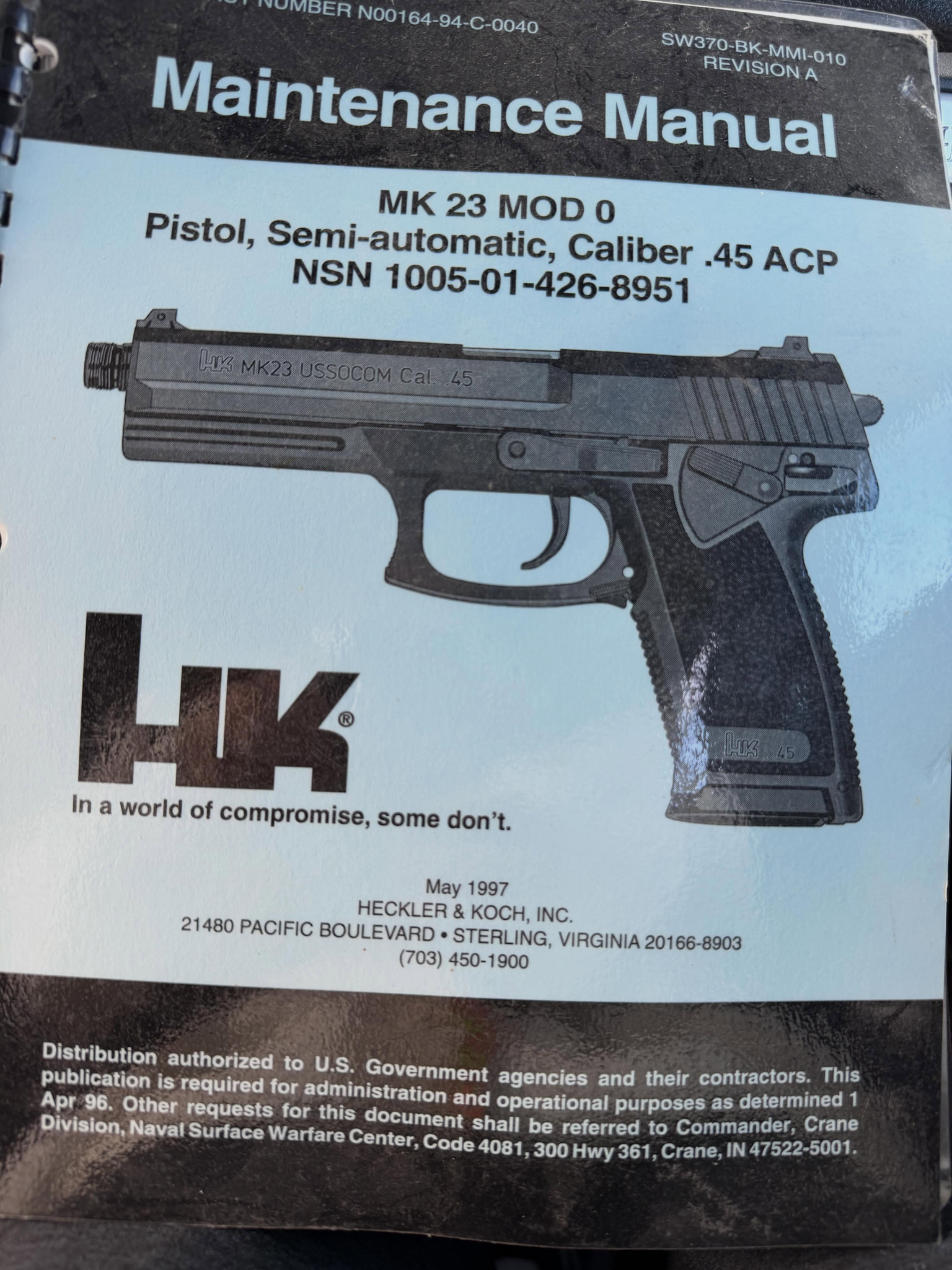
The photograph shows a physical copy of the MK23 Mod 0 Maintenance Manual, document SW370-BK-MMI-010, Revision A, May 1997. The cover identifies the military .45-ACP pistol and its NSN, 1005-01-426-8951. This is maintenance documentation for the pistol; it should be distinguished from the commercial Operator’s Manual used elsewhere in this dossier.
An online scan of the same revision identifies the May 1996 edition as its predecessor (printed page 6, PDF page 4). It adds a contemporary maintenance-document perspective to the later manufacturer accounts. It does not establish the contents of every issued OHWS package or a complete manual set for the suppressor and laser aiming module.
The scan is privately hosted, carries added notices and watermarks, and cannot be confirmed as complete in its preliminary pages. It is identified here as a historical reproduction, rather than an officially released original file. Its title page also differs in design from the photographed outer cover; the document number, revision and date agree.
The table separates provenance, evidential value and limitations. Manufacturer material can also be promotional, and a detailed account of one person’s service does not establish the experience of other units.
| Source | Source type | Appropriate use | Limitation | Class |
|---|---|---|---|---|
| HK Mark 23 Operator’s Manual | Manufacturer document | Mechanism and operation of both pistols; terminology; manufacturer summary of testing | Not a complete OHWS system manual or official raw dataset | A |
| MK23 Mod 0 Maintenance Manual, Revision A (1997) | Historical manufacturer document in a private reproduction | Document identity and maintenance purpose | Preliminary pages may be incomplete; no official public-release status established | A / copy |
| HK Defense HK Mk23 | Manufacturer document | Official manufacturer presentation of delivery, MRBS and endurance | manufacturer account; roughly 6,000 as an average differs from the manual’s lowest result of 6,027 | A |
| HK patents US5654519A and US5309815A | Patent document | Intended technical function of centring and buffering | Do not alone prove every production implementation | A |
| ANSI/SAAMI Z299.3 | Technical standard | Commercial .45 Auto cartridge and chamber dimensions | Does not contain the military HK Mk23 government drawing | A |
| 1911 Syndicate / Dave Hall | Participant account | First-hand testing, employment and holster experience with timestamps | Passage of time; no complete official file | B |
| Forgotten Weapons / former HK Grey Room | Object presentation and specialist publication | Direct examination of surviving development configurations | Presenter was not a programme participant; figures require primary-source verification | B/C |
| Soldier of Fortune, December 1997 | Specialist publication | Contemporary technical account including Safariland/Rogers holster | Magazine article, not a contract or packing list; observations may be specimen-specific | C |
| Small Arms Defense Journal / Bartocci | Specialist publication | Detailed technical secondary account of testing and system components | Hosted by HK, but a secondary article rather than an official programme record; individual details still require checking | C |
| Military Arms Channel | Civilian demonstration / experience report | KAC mounting, functional demonstration and own sound-measurement series | Civilian pistol without LAM; not an official measurement | C |
| Garand Thumb | Civilian experience report | Modern civilian practical demonstration | Modified civilian pistol; no historical programme participation | C |
| The Firearm Blog / Nicholas C | Specialist publication / civilian experience report | Civilian practical test, size comparisons, accessory and variant photographs | Some historical statements and inferred quantities lack primary evidence; third-party image rights | C |
| mark23.de | Private documentation / research lead | Original photographs and documents relating to one German civilian pistol; historical evidence of the contemporary civilian market | Military history largely uncited and partly incorrect; not independent OHWS evidence | C/D |
| German and English Wikipedia | Encyclopaedia / research lead | Orientation and identification of possible literature | Not used as evidence; mixed-quality sources, unsupported user lists and questionable technical claims | D |
| Dealer, collector and forum statements | Dealer, collector or forum statement | Research leads, market observation and documented individual specimens | Not a factory ledger or official user/delivery confirmation | D |
Source assessment: mark23.de and Wikipedia
Since 2002, mark23.de has documented a German civilian pistol through original photographs, scans and package records. Its value lies in that particular example and the civilian market of the period. The military-history text often repeats older HK promotional claims without individual references. Its distinction between conventional military and polygonal civilian barrels contradicts HK’s manual. The site is therefore not used as independent confirmation of OHWS history.
The German Wikipedia article repeats material from mark23.de; several technical statements and infobox values lack adequate sourcing. The English Wikipedia offers more literature references but mixes sources of varying strength. User lists and exceptional claims need their own evidence. CYBERSMART
Publicly accessible bibliography
Primary and manufacturer sources
- Heckler & Koch, HK Mark 23 Operator’s Manual, revised public edition, January 2024; title page states applicability to the HK Mark 23 and HK Mk23 Mod 0 pistols.
- Heckler & Koch, MK23 Mod 0 Maintenance Manual, SW370-BK-MMI-010, Revision A, May 1997; privately hosted reproduction, completeness and official public-release status unconfirmed.
- Heckler & Koch, Mark 23 Operator’s Manual, August 2026. Separate, more recent commercial edition; the historical trial figures in this dossier remain tied to the January 2024 edition.
- Heckler & Koch, HK Mk23—Military/Law Enforcement (LE) presentation.
- Heckler & Koch, FAQ on publicly available and restricted manuals.
- Heckler & Koch, HK MARK 23—current product page.
- Heckler & Koch, Civilian Catalog 2005.
- Heckler & Koch GmbH, US5654519A—Automatic pistol.
- Heckler & Koch GmbH, US5309815A—Firearm, particularly handgun.
- SAAMI, ANSI/SAAMI Z299.3—Centerfire Pistol & Revolver.
Contemporary and technical secondary sources
- *Soldier of Fortune*, December 1997, contemporary HK Mk23 article including holster description.
- Christopher R. Bartocci, HK Mk23 Mod 0—The Crew-Served Pistol, Small Arms Defense Journal.
- mark23.de, historical private documentation of a German civilian pistol; used only for the owner’s original artefacts and evidence of the contemporary civilian market, not as an OHWS primary source.
Public audiovisual sources
- 1911 Syndicate, The Untold Story of the HK MK23 SOCOM Offensive Handgun, interview with Dave Hall, published 27 October 2023.
- Forgotten Weapons, H&K Mk23 SOCOM .45 Development, presentation in the former HK Grey Room, published 28 June 2019.
- Military Arms Channel, HK Mk23 Mod 0 OHWS with KAC Silencer, civilian demonstration of a KAC suppressor, published 22 May 2018.
- Garand Thumb, From Metal Gear Solid To Navy SEALS; The HK MK23 SOCOM, modern civilian practical test, published 8 February 2026.
Orientation sources and civilian variants
- German Wikipedia and English Wikipedia: used only for orientation and source discovery, not as evidence.
- Nicholas C, Review: H&K MARK23 The Civilian Version HK MK23 SOCOM, The Firearm Blog, 28 June 2018; civilian practical test and collector article. Production and programme history require primary-source confirmation.
- all4shooters, IWA 2024: Heckler & Koch special editions presented by WAIMEX.
- 507 Outfitters, HK Mark 23 OD Green, dealer evidence with limited probative value.
Editorial note
This edition uses only publicly accessible sources. Private book scans, non-public literature extracts and the private CYBERSMART
Source status
- Primary sources: HK pistol manual · HK patents
- First-hand account: Dave Hall · role and timestamps identified
- Open questions: contract quantity · international users
- Lead photograph: civilian HK Mark 23 · credited and licensed; not evidence of a military-issued OHWS
Continue reading
Series introduction: Requirements and Models