Salt-laden air, spray and a wet holster are routine conditions along the coast and aboard a boat. A service pistol has to withstand that exposure for years and remain dependable when needed. This is the requirement behind the HK SFP9 M: a sidearm intended for regular use in a maritime environment.
Its relevance extends beyond combat swimmers. Boarding teams, water police and other coastal personnel have different jobs, but their equipment shares some of the same burdens. The useful questions are straightforward: what did HK change, what has been tested, and which users can actually be documented?
Start with the requirement
The HK SFP9 M belongs to Heckler & Koch’s service-pistol family. It is a fully pre-cocked, striker-fired pistol chambered in 9 × 19 mm, using a modified Browning locking system. In police service, a pistol of this type can be the officer’s primary duty weapon; in military service, it will typically serve as a secondary weapon.
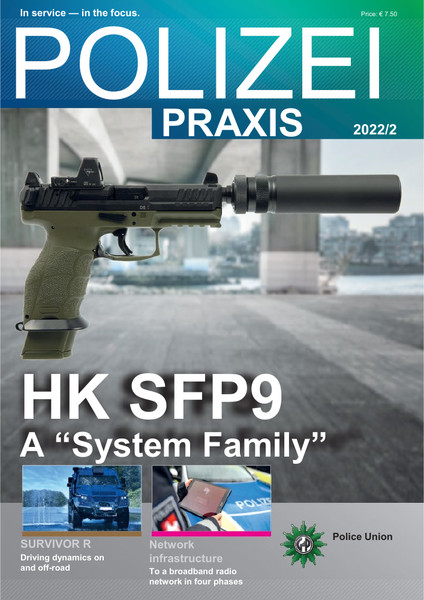
The cover of POLIZEIPRAXIS 2022/2 presents the SFP9 as a “System Family”. It shows a configuration with a red-dot sight and suppressor; the cover image does not identify the M variant. The maritime features are discussed on pages 17–19. Author Marc Roth is HK’s product strategist, so the article is assessed here as a manufacturer account.
HK product strategist Marc Roth gives a specific account of the maritime requirement in Polizeipraxis 2022/2, pages 17–18. According to Roth, a German intelligence service requested a version for boarding personnel. It had to withstand sea air and spray during operations from inflatable boats and remain reliable if its user went overboard.
That is a practical equipment requirement. Routine exposure to salt and moisture can cause corrosion in small components and awkward recesses, increasing maintenance demands and ultimately affecting readiness. A maritime configuration can therefore earn its keep during ordinary coastal and harbour duties, well before any diving requirement enters the picture.
What makes it the maritime version?
The HK manual, section 4.10, page 30, specifies a saltwater-resistant coating. HK also reports retained usability following salt-spray and long-term saltwater tests under the cited NATO AC225 requirements. These are manufacturer claims about defined environmental tests. They do not establish a separate “NATO certification”.
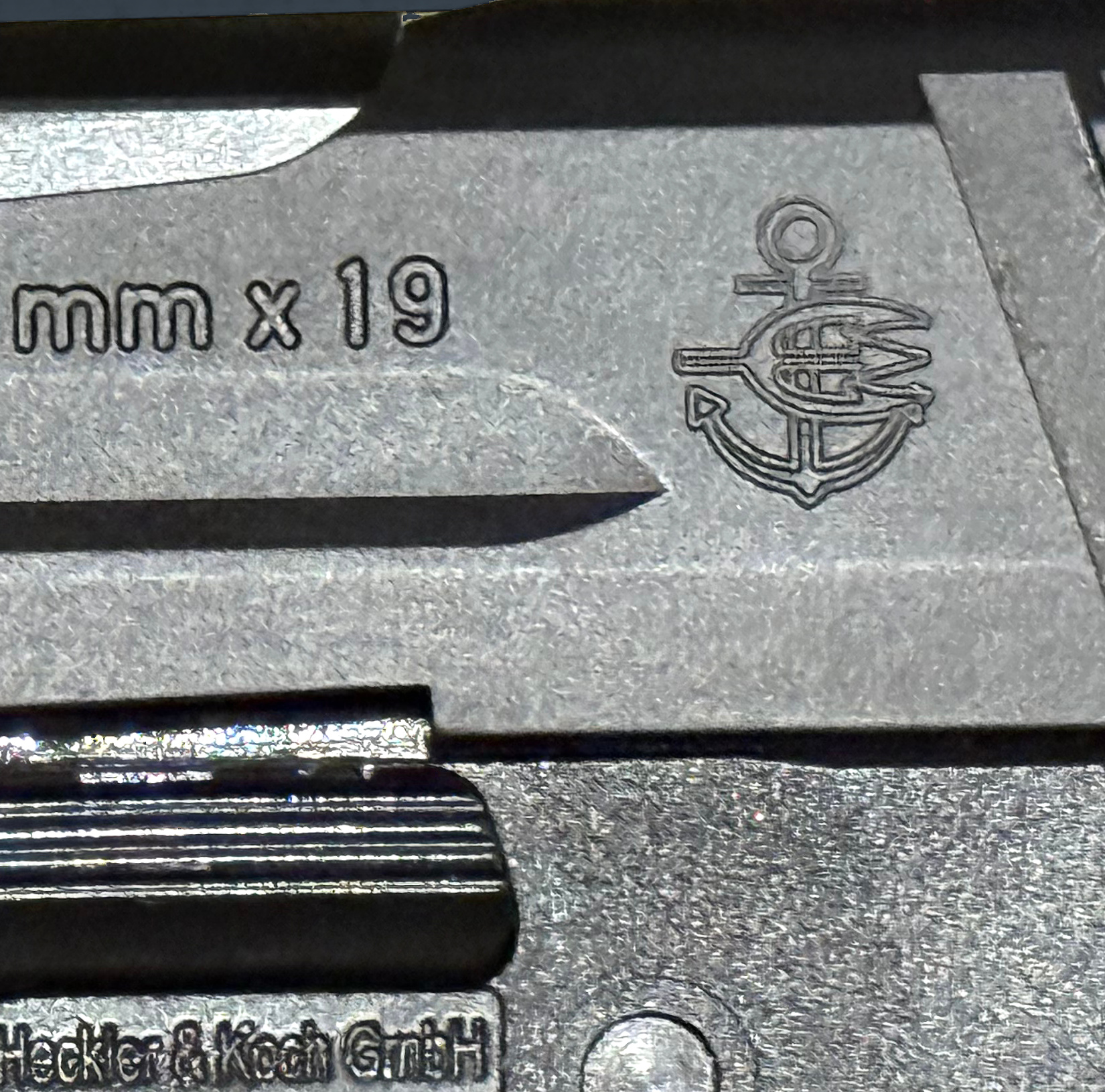
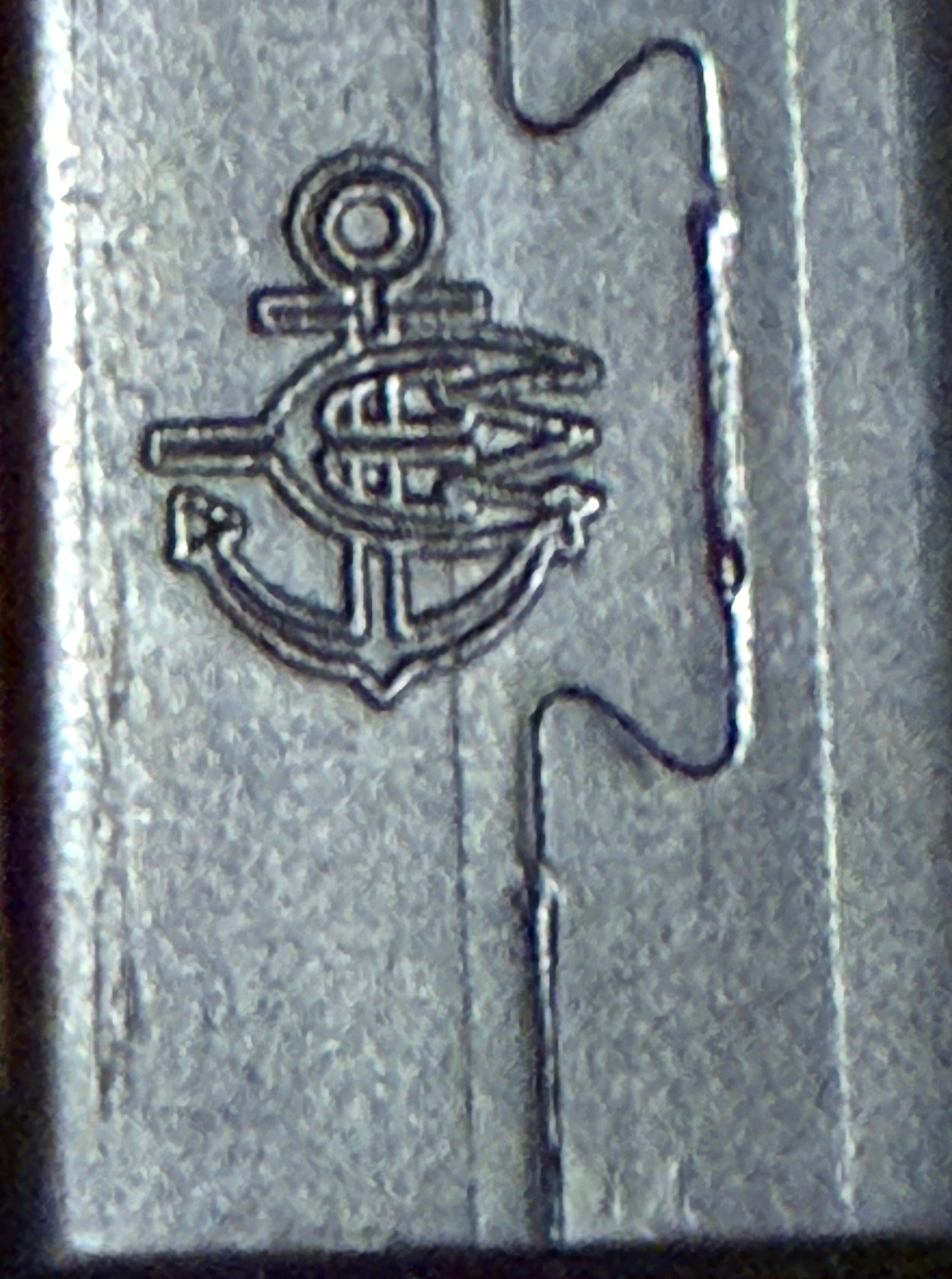
Roth identifies the anchor-and-trident emblem, M marking and more pronounced slide serrations as external features. He states that holster and accessory interfaces match the standard versions, helping the pistol fit existing equipment. Its maritime capability still rests on the actual design claims and test evidence, rather than the markings alone.
The magazine of the example shown here also carries the anchor-and-trident marking, visible in the publisher’s own photograph. The emblem alone does not establish how individual magazine components were coated or tested.
The precise configuration matters for the trigger as well. HK lists the maritime version with both the Technische Richtlinie (TR) German police trigger specification and the Special Forces (SF) trigger. SF denotes a different trigger characteristic with shorter travel. The M designation alone therefore does not establish a unique “maritime trigger” common to every example.
Over the Beach and firing underwater
Water exposure raises three separate questions: corrosion resistance, readiness immediately after emerging, and functioning while firing underwater. HK has published claims about all three for the HK SFP9 M.
The HK advertorial in the June 2017 issue of ES&T, PDF page 7, already advertised reliable underwater functioning. Roth’s 2022 account, page 19, footnote 21, is more specific: during internal company trials, the HK SFP9 M reportedly fired repeated strings of two consecutive 15-round magazines while submerged in 50 cm of water, without malfunctions. The slide also locked back after the final round. This describes functioning as a self-loading pistol underwater, including the cycling action, rather than simply surviving immersion.
Roth distinguishes this from Over the Beach (OTB) capability: his account describes safe, reliable firing while partly submerged and immediately after emerging or being removed from the water. The underwater trials are a specific manufacturer report. They do not establish unrestricted approval for different depths, ammunition or operating conditions; a complete independent test report is not available in the material reviewed here.
Who uses the HK SFP9 M?
The evidence needs a little sorting. A 2018 government response from Mecklenburg-Vorpommern documents issue of the HK SFP9 TR. Roth identifies the version introduced there as the HK SFP9M-TR. The maritime designation comes from the manufacturer’s article.
For Japanese special forces, Marc Roth’s 2022 HK article, page 17 explicitly reports adoption of the HK SFP9 M, including by the ground and air services. This is a manufacturer claim; the Japanese government documents reviewed here do not independently confirm adoption of the M version.
| User connection | Source | What it supports |
|---|---|---|
| Mecklenburg-Vorpommern state police | Government response, 2018; HK article, 2022 | HK SFP9 TR issue officially documented; maritime HK SFP9M-TR identification supplied by HK |
| Japanese special forces | HK article, 2022 | HK SFP9 M adoption reported by the manufacturer; the cited government documents do not identify this variant separately |
Government context for the SFP9 family: The FY2022 defence budget, page 47, and the FY2024 procurement plan, PDF pages 1–3 (archived 27 May 2024), name the SFP9 without the M suffix. They establish neither procurement of the M version nor completed issue. They are included to distinguish general SFP9 procurement from the manufacturer’s maritime-variant claim.
The familiar German combat-swimmer connection also warrants a closer look. The description of Vickers Tactical’s video dated 28 November 2020 attributes development to a combat-swimmer request. Roth identifies the intelligence-service requirement and explicitly distinguishes that development origin from requests by combat swimmers or mine-clearance divers. These are competing accounts of how the project began. They neither establish nor rule out subsequent use by the German Navy’s Kommando Spezialkräfte der Marine (KSM). No public primary source confirming procurement or issue by KSM or the German Federal Police’s GSG 9 was identified in the material reviewed for this article.
Specifications at a glance
Current figures come from HK manual 015.0426, page 31, and the product page with the M variant specifically selected, checked on 28 October 2026.
| Specification | HK SFP9 M: manufacturer figure |
|---|---|
| Calibre | 9 × 19 mm |
| Length × width × height | 186 × 33 × 138 mm |
| Barrel length / sight radius | 104 / 162 mm |
| Weight without magazine or accessories | 620 g on the product page |
| Empty 15-round magazine | 93 g on the product page |
| Listed magazine options | 15, 17 and 20 rounds |
| SF trigger in the current M data | 22 + 5 N; travel 6 mm; reset 3 mm |
The older English HK manual 013.0721, page 30, lists 710 g with a magazine. The different weighing conditions matter when comparing figures. Today’s magazine options likewise do not establish the contents of an earlier procurement package.
What the HK SFP9A1 carries forward
The new HK SFP9A1 does incorporate maritime features. HK’s military and law-enforcement product page specifies a maritime slide design with additional serrations. Its German manual dated May 2026, page 24, also lists a special coating for maritime use. It does not clearly identify which configurations receive that coating. The documents reviewed likewise provide no corresponding AC225 salt-test qualification or the OTB and underwater trials described for the HK SFP9 M. Maritime features are documented; equivalent maritime qualification across the A1 family remains unconfirmed. That is a gap in the evidence, rather than proof that the new pistols lack the capability.
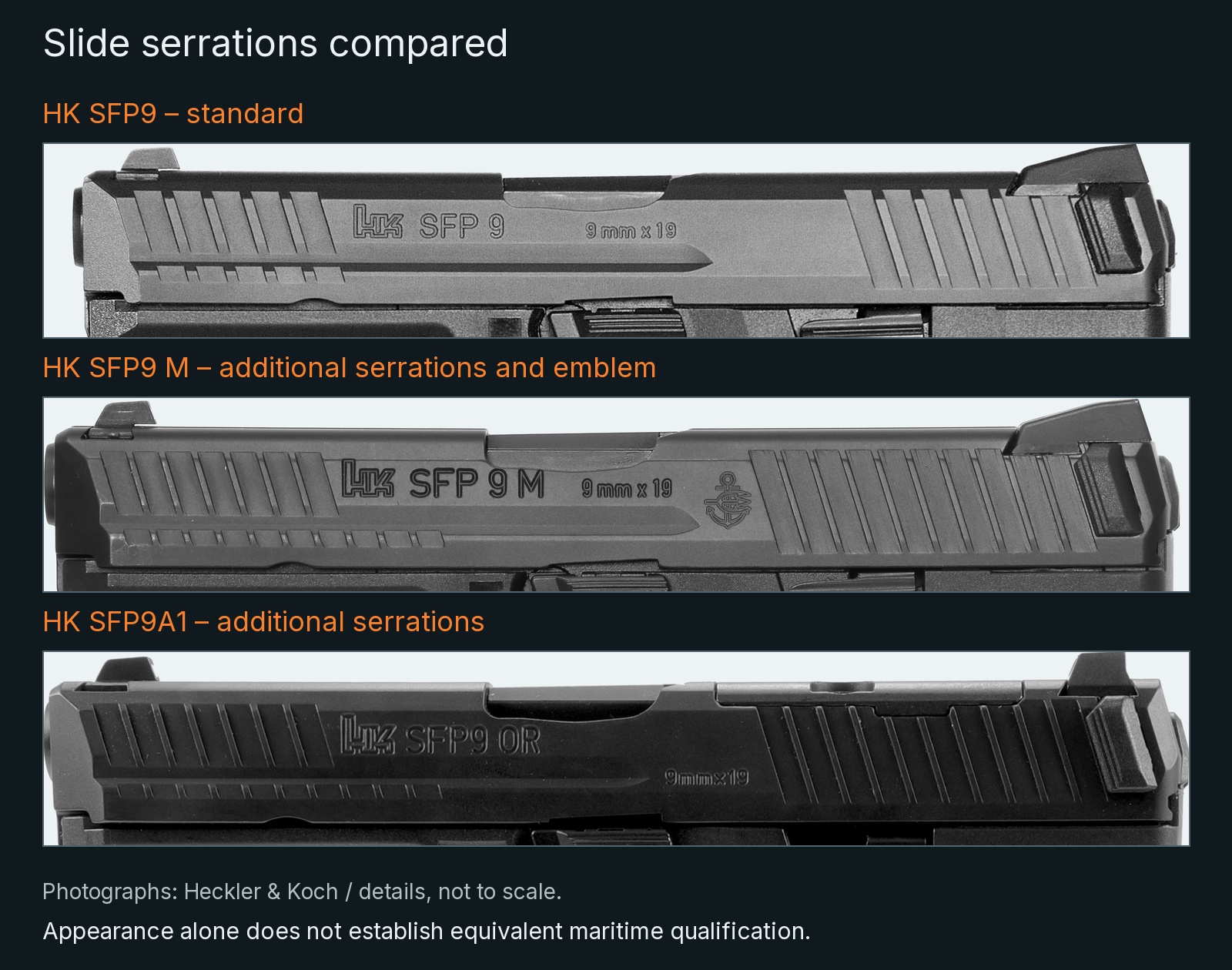
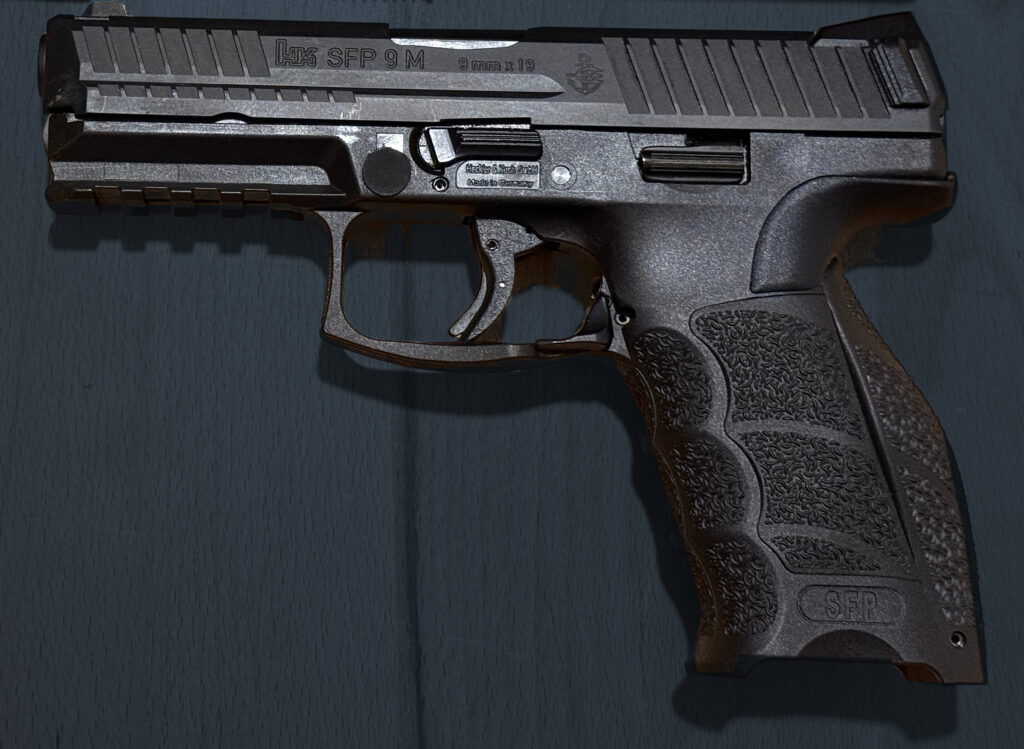
Looking directly at the slides makes the difference tangible: the standard SFP9 shown here has a different serration pattern from the M and A1. The latter two show additional serrations; the M also carries the anchor-and-trident emblem. The pistol pictured on HK’s A1 product page is marked “SFP9 OR”, without a visible A1 suffix. This comparison documents external features; it cannot establish identical coatings or the same maritime trials.
For magazines, HK describes a construction backward-compatible with the HK P30 and earlier HK SFP9, together with a revised “Grip & Rip” baseplate. The A1 manual, page 16, also refers to the family’s shared magazine basis. This establishes a logistics concept, rather than a complete compatibility chart covering every old and new magazine, baseplate and grip size. The shorter HK SFP9K A1 particularly needs to be considered separately. The material reviewed provides no specific manufacturer evidence of maritime corrosion protection or corresponding tests for individual A1 magazines. Matching capacity alone does not establish an identical magazine either.
The same model-specific approach applies to the HK SFP9 SK and HK SFP9CC in the current official range. HK lists them as separate compact variants, while the explicitly M-designated version is standard-sized. No corresponding maritime coating or test evidence was found in the model-specific descriptions reviewed for the SK and CC. That finding does not settle the specification of any unpublished government configuration.
Its place in the maritime series
The HK SFP9 M shows how a service pistol can be adapted to maritime requirements. Its role encompasses routine coastal exposure alongside the particular water-related capabilities described by HK. When tracing service use, the decisive question remains which configuration a customer actually received.
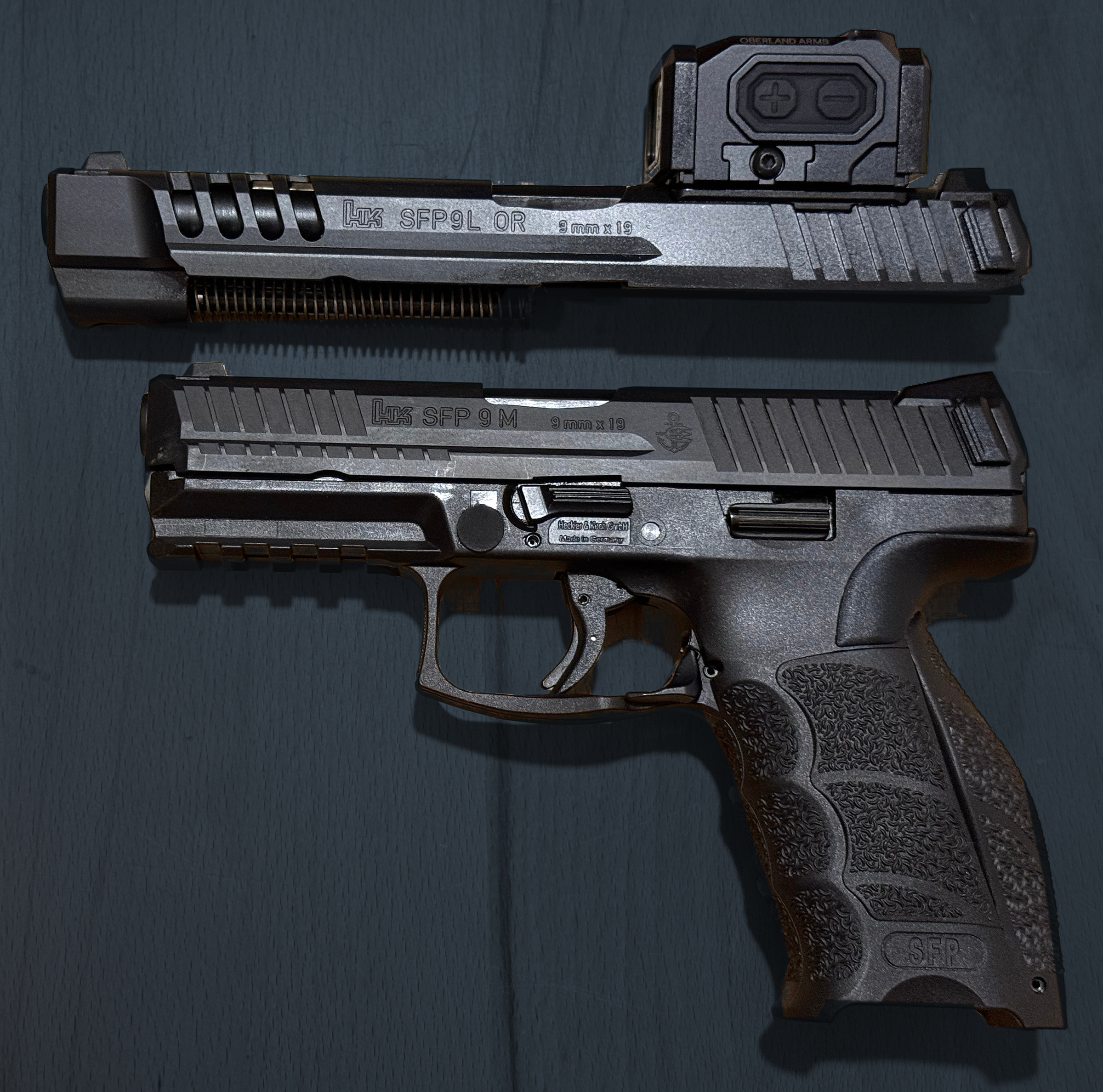
Publisher Uwe Betz acquired an HK SFP9 M on the civilian market. He also owns a civilian HK Mark 23 in Flat Dark Earth (FDE). That personal connection is one starting point for examining these pistols. The claims about trials and service use come from the linked sources; this article does not present private maritime testing.
The publisher’s own photographs show the SFP9 M with the separately purchased SFP9 L OR conversion slide above it. The close-ups document the anchor-and-trident emblem on the M’s slide and magazine. The wooden surface was colour-graded; the visible firearm features were preserved.
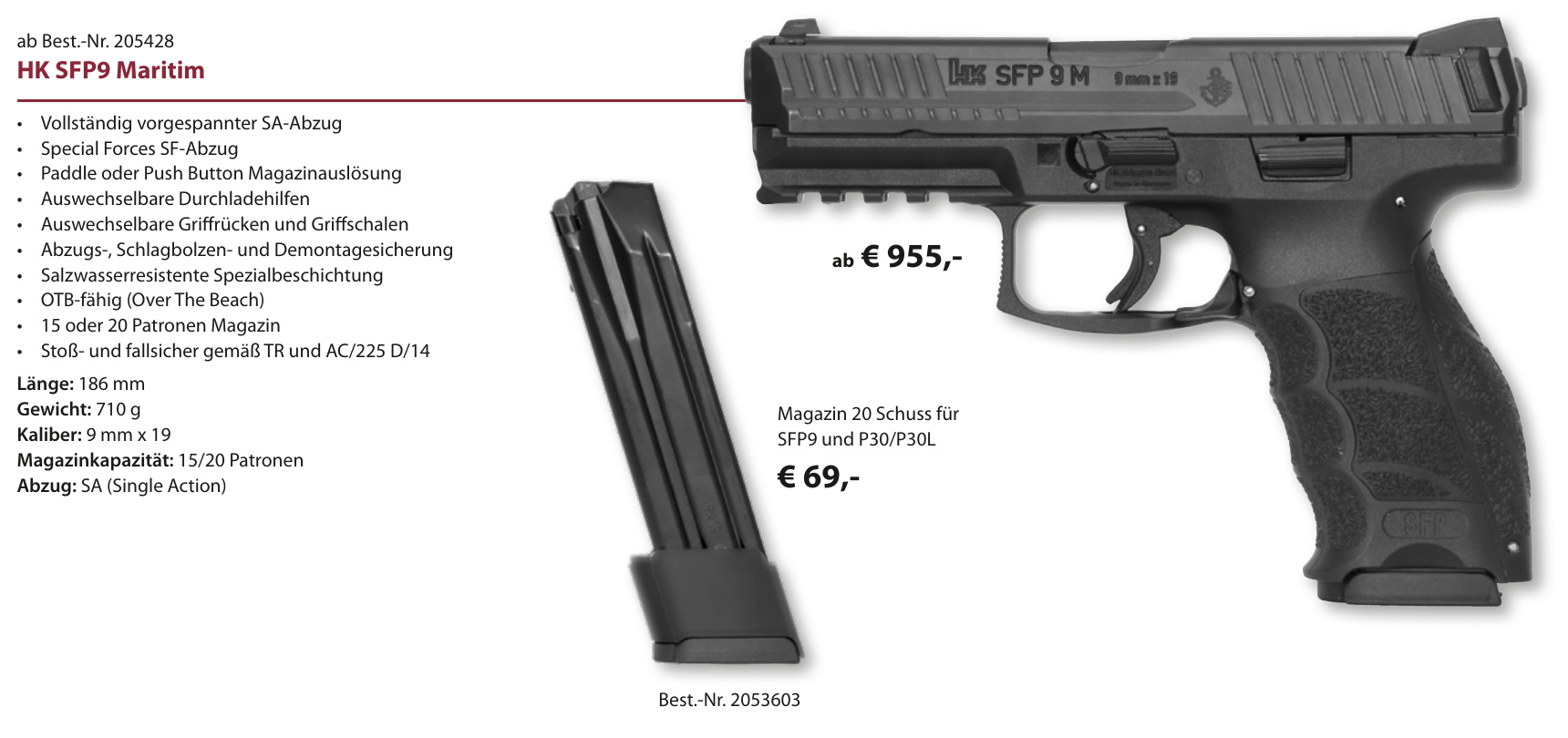
A historical commercial offer is documented in the WAIMEX catalogue 2019, page 126. It lists the complete HK SFP9 Maritim under order numbers starting at 205428, at a price starting at €955.
The pictured pistol carries the “SFP9 M” marking and the anchor-and-trident emblem, identifying the catalogue entry as the M variant. Its inclusion in this general hunting and sporting firearms catalogue documents the offer through the firearms trade. The entry does not establish how many pistols were delivered to civilian owners, how long they remained available or whether this was a one-off release.
In the publisher’s assessment, the SFP9 M is likely to be uncommon in civilian ownership in Europe; however, reliable figures are not available.
For the United States, a HK Proshop member reported 149 examples in stock at Arms Unlimited on 1 February 2022. The contemporary forum post states “149 in stock as of now”. This stock report is not a confirmed delivery quantity and does not establish the total number imported or sold on the US civilian market.
The HK Mk23 dossier examines the military HK Mk23 Mod 0 as part of the Offensive Handgun Weapon System (OHWS), comprising pistol, suppressor and laser aiming module. The HK SFP9 M has its own requirement profile. A shared maritime focus does not establish that it replaced the complete military weapon system.