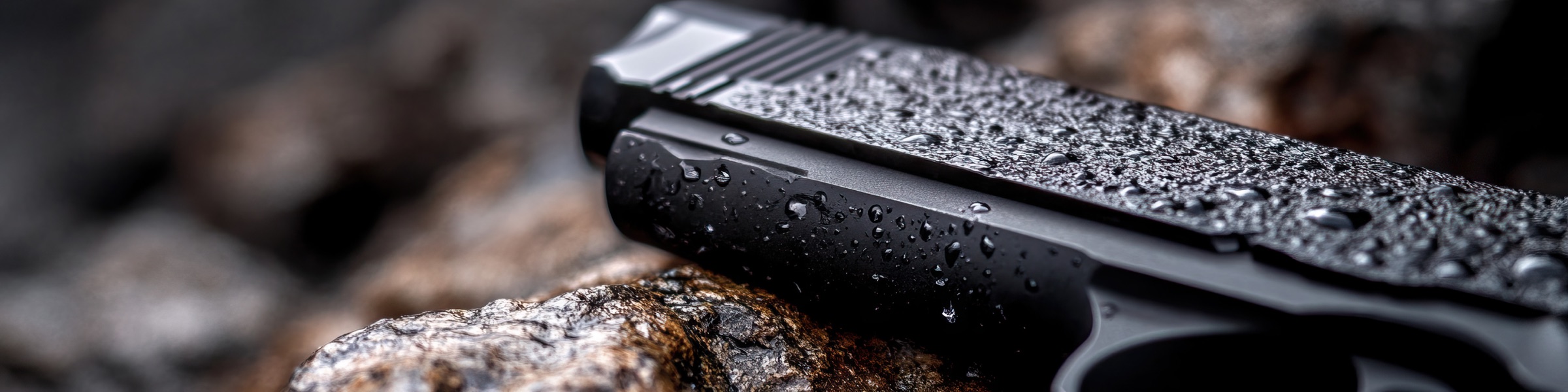
Salt spray alongside, green water over the deck, or a mission that includes a submerged approach: each places different demands on a sidearm. This series examines which requirements a handgun system is documented to meet—from corrosion resistance to the specialised demands of firing underwater.
Part of the Maritime Systems topic cluster, Maritime Handgun Systems covers military and law-enforcement use from 1990 onwards. The European connection comes through the manufacturer or a documented European user; service elsewhere is included where relevant. Earlier designs provide clearly identified historical context.
Who carries a handgun in the maritime environment?
- Military (MIL): ships’ crews and force-protection personnel, boarding teams and maritime special operations forces. Combat divers add a deliberate submerged phase to the requirement. That does not make every naval sidearm an underwater weapon.
- Law enforcement (LE): waterway and harbour police, armed coast guards and specialist maritime intervention units. Their priorities often concern sustained coastal exposure, spray and accidental immersion rather than deliberate underwater use.
HK author Marc Roth identifies the HK SFP9M-TR in Mecklenburg-Vorpommern as an LE example. His account associates the Japanese procurement with the armed forces. It does not establish Japanese LE use of the M variant. [2]
Five operating conditions. Five distinct evidence thresholds.
- Salt spray and humid sea air: corrosion resistance matters on routine coastal and harbour duties, well before a weapon enters the water. Magazines, springs and concealed metal surfaces belong in the assessment.
- Spray and green water on deck: a brief drenching is different from prolonged immersion. A protective finish alone says little about whether the complete weapon will function afterwards.
- Submerged carriage: the evidence must identify the weapon configuration, exposure duration, pressure or depth limits, and subsequent function.
- Readiness after surfacing: this comparison uses Over the Beach (OTB) for the transition from submerged carriage to firing in air. Immediate function and function after prescribed intervening measures are separate claims.
- Underwater firing: this requires specific evidence for both weapon and ammunition. OTB capability does not establish it, and a reported test does not amount to unrestricted operational clearance.
The requirement covers the whole loadout. Weapon, ammunition and associated kit must be assessed together. Corrosion protection does not remove maintenance requirements; lubricants, service intervals, seals and coatings must remain compatible with the approved configuration. A robust pistol does not establish that its ammunition withstands the same exposure. The individual studies separate those evidence trails. This introduction is not an operating manual.
Model matrix: documented capability and evidence gaps
The matrix compares the available evidence, not a league table of pistols. “Not established” means that the sources reviewed do not substantiate the capability. It is neither a finding of unsuitability nor an approval for use. Manufacturer claims are identified as such.
| System / source | Corrosion protection | Underwater carriage | OTB / readiness after surfacing | Underwater firing |
|---|---|---|---|---|
| HK Mk23 / HK Mark 23 [3] | Maritime finish; HK reports salt-spray and surf trials | Water operations covered; submerged-carriage limits not established here | Manual does not establish unrestricted OTB clearance | Not established |
| HK SFP9 M [1] [2] | Special coating; salt-spray and saltwater testing claimed by HK | Water exposure covered; no unrestricted diving-depth clearance | Reported in an HK technical publication | HK reports in-house shallow-water firing trials; evidence limited to those tests |
| SIG Sauer P226 Mk25 [4] | Corrosion-resistant internal coating; phosphate-coated, chrome-lined barrel | Not established | Not established | Not established |
| GLOCK with Maritime Spring Cups [9] | Salt-test results for the specific configuration not established | Model-specific limits not established | Maritime component documented; complete OTB qualification not established | No unrestricted clearance established |
| AREX DELTA 4AMP [10] | Catalogue does not specify salt-test results | Submerged-carriage limits not established | Marketed as OTB-ready; acceptance criteria not published in the catalogue | Not established |
| Walther P14 / Walther P14K [11] | Specific corrosion-test results not established by the reviewed public sources | German naval special forces named as an intended recipient; diving limits not established | Not established | Not established |
| HK P11 [5] | Comparable public test results not established | Designed as a specialist underwater weapon | Distinct ammunition variants; not equivalent to a conventional OTB pistol | Underwater configuration documented; no inference of current operational clearance |
Heckler & Koch supplies two contrasting cases: the purpose-marketed maritime HK SFP9 M and the HK Mk23 within the Offensive Handgun Weapon System (OHWS). The HK Mk23 manual specifies measures before firing after water exposure. That wording cannot be treated as unrestricted OTB clearance. [3]
SIG Sauer emphasises corrosion protection for the SIG Sauer P226 Mk25. Its European connection is rooted in the SIG Sauer P226 family: a U.S. Government Accountability Office (GAO) report lists Switzerland’s SIG as the supplier. This historical link does not establish European manufacture of every current SIG Sauer P226 Mk25. [4] [8]
GLOCK lists Maritime Spring Cups in its Gen4 manufacturer catalogue. That documents a component option, not blanket OTB or underwater-firing clearance across models and generations. [9]
AREX markets the AREX DELTA 4AMP family as OTB-ready, but the catalogue does not publish the full acceptance criteria. Walther names the Kommando Spezialkräfte der Marine (KSM; German naval special forces) among the intended recipients of the Walther P14/Walther P14K. An identified customer and a documented underwater capability are different findings. [10] [11]
The HK P11 warrants a concise article as a historical specialist design. Examination of a surviving example documents separate ammunition variants for use in air and underwater. Named users, service after 1990 and present status still require their own supporting evidence. [5]
Reading procurement notices and test requirements
Procurement notices help establish what a customer ordered or sought—but only within their stated scope. TED 185994-2026 concerns a Lower Saxony tender for HK SFP9 service pistols. The notice alone establishes neither the M variant nor an OTB requirement. [7]
The German Police University (DHPol) testing guideline, 2021, section 3.6.5, offers a more specific technical reference. It addresses function after saltwater exposure and includes drainage. It therefore does not establish immediate readiness without an intervening step, or underwater firing. A public maritime specification with fully verified OTB acceptance criteria has not yet been established for this overview. [6]
Where to start
- Series introduction: the users, operating conditions and model matrix on this page.
- HK Mk23 Mod 0 OHWS—the opening dossier, examining development, trials and the complete system.
- To follow: individual studies of the HK SFP9 M, SIG Sauer P226 Mk25, GLOCK with maritime equipment, AREX DELTA 4AMP and Walther P14/Walther P14K, plus a shorter HK P11 article. The available evidence determines the depth of coverage.
The planned Maritime Units series will examine the users and link back to their equipment. It belongs under Units; Maritime Systems brings together the equipment studies. Readers can follow the connection between organisation, task and kit without losing the distinction between them.
Sources and evidence limits
- [1] HK: HK SFP9/SFP40 Operator’s Manual, § 4.10
- [2] Marc Roth (HK): HK SFP9 System Family, Polizeipraxis 2/2022, pp. 17–19
- [3] HK: HK Mark 23 Operator’s Manual, January 2024 revision, pp. 6 and 17
- [4] SIG Sauer: Defense Catalog 2026, MK25, p. 68
- [5] Ian McCollum: HK P11, examination of a Royal Armouries specimen, 2023
- [6] DHPol/PTI: Pistol testing guideline, version 4 (2021), § 3.6.5
- [7] TED 185994-2026: Zentrale Polizeidirektion Niedersachsen, 18.03.2026
- [8] U.S. GAO: Army Procurement of Beretta’s 9mm Semiautomatic Pistol, Table I.1
- [9] GLOCK: Gen4 Buyer’s Guide, p. 15, manufacturer catalogue (copy hosted by Krale)
- [10] AREX: A-PRO catalogue, AREX DELTA 4AMP family, pp. 25–31
- [11] Carl Walther: Special Forces tender, Walther P14/Walther P14K and intended users